How a Solar Cell Turns Light into Current
How a solar cell turns light into current, what its junction and contacts do, and how to trace the process without confusing cell output with household power.
The most common mistake about a solar cell is to treat it as a tiny socket that sends electricity straight from sunlight to a home. The cost of that shortcut is confusion about what the cell actually does: it changes light into electrical output, while the rest of the system has separate jobs.
Follow the charge through the cell and its contacts, and you can see where the conversion happens without wandering into the wiring and equipment that serve a household.
Light frees charges
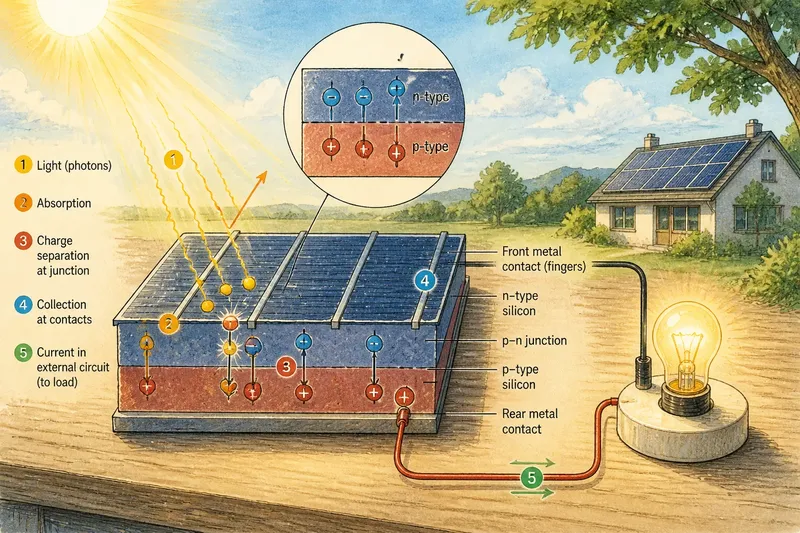
Sunlight carries energy in packets called photons. When photons reach a silicon cell, some bounce away, some pass through, and some are absorbed. An absorbed photon can transfer energy to an electron in the silicon, allowing it to move from its usual bond and leaving behind a vacancy called a hole.
Not every photon creates a useful moving charge. Whether it does depends on the light and the semiconductor material. Absorbing light is only the start: the cell must also separate charges and collect them.
Think of light as supplying the energy for the process, not as a completed stream of electricity.
The junction separates charges
A solar cell’s silicon is treated to create regions with different electrical properties. Where they meet, they form a junction with an internal electric field. This field directs electrons and holes towards different sides of the cell; it is built into the material, not produced by a moving part.
That separation creates an electrical potential difference between the cell’s sides, called voltage. Voltage is an electrical push between two points, but it is not the same as current: current is charge moving through a circuit.
Without a connected route, separated charges do not keep flowing through an external device. The junction makes a useful flow possible, but the circuit must give the charge a path.
Contacts collect the flow
Fine metal lines on the cell’s front collect charge while leaving much of the silicon exposed to light. A conductive contact on the rear completes the pair. The front lines involve a design trade-off: more metal can collect charge, but it also shades the silicon underneath.
Connect the two contacts through a suitable external circuit and charge can flow through that route, delivering electrical energy to a connected load. The cell’s contacts are therefore working parts, not decorative stripes.
A worked cell example
Say you have a small silicon cell under a desk lamp, with its two contacts connected to a suitable low-voltage lamp. The starting point is the illuminated cell and the intact circuit; the lamp is the load that receives energy.
As light reaches the silicon, absorbed photons can free charges. The junction directs electrons and holes towards different contacts, and the closed circuit lets charge move through the small lamp. The expected observable result is that the lamp may glow; if it does not, the result does not identify a single cause, so check that the circuit is closed and that the lamp and cell are suitable for one another.
This is a small illustration of cell-level conversion, not a model of how a roof-mounted system supplies household appliances.
What changes the output?
The light reaching a cell affects how many photons are available to be absorbed. Shade, cloud, the angle of incoming light and the cell’s temperature can all affect its electrical behaviour. They change the conditions for output, not the basic sequence of light absorption, charge separation and collection.
A cell does not store sunlight for later. It converts some incoming light energy while light is being absorbed, so its available electrical output can change as illumination changes.
Read a cell’s output as a response to light and circuit conditions, not as a fixed household supply.
Solar cell or panel?
A solar cell is the semiconductor device where light is converted into electrical output. A panel, also called a module, combines multiple cells and provides terminals for connection to other equipment.
That boundary matters: a cell does not manage household electricity or decide where energy goes. It provides the starting electrical output; other parts of a solar installation handle the tasks beyond the cell.
Questions about solar cells?
Does a solar cell need direct sunshine?
No. A cell can respond to diffuse daylight as well as direct sun, although the light reaching it differs and the available output can change. The process still depends on photons being absorbed by the semiconductor.
Why does a solar cell need a junction?
The junction’s internal electric field directs electrons and holes towards different sides of the cell. That separation supports voltage and, when a circuit is connected, current.
Is a solar cell the same as a solar panel?
No. The cell is the light-absorbing semiconductor device; the panel combines multiple cells and provides terminals for connecting its output to other equipment.
Does a solar cell store sunlight?
No. It converts some incoming light energy into electrical energy while light is being absorbed. Storing electricity for later requires separate equipment, not the cell itself.
Trace the cell’s role
To keep the process clear, check each link and decide what the observation tells you:
- Light on the silicon: Check whether light reaches the cell; if it does, photons are available for absorption, but if shade covers it, expect less light to reach the material and remove the shade if practical.
- Absorption: Ask whether the cell’s material absorbs incoming photons; if it does, charges can be freed, but if light is reflected or passes through, that light contributes no charge and the cell’s output cannot be inferred from brightness alone.
- Charge separation: Identify the junction between differently treated regions; if present, its internal field can direct electrons and holes, but if the junction is damaged, have the cell assessed rather than assuming it will separate charges normally.
- Contact collection: Check whether the front and rear contacts provide collection points; if both are intact, charge can reach the circuit, but if a contact is broken, the collection route needs attention.
- Closed circuit: Check whether the contacts connect through a complete external path; if the route is closed, current can flow through a suitable load, but if it is open, reconnect or repair the circuit before expecting current through the load.
- Suitable load: Check whether the connected device is suitable for the cell’s output; if it is, it may receive electrical energy, but if it is not, choose a compatible load rather than treating a lack of visible response as proof that the cell makes no output.
- Changing illumination: Check whether clouds, shade or the light angle changes; if illumination falls, available output may change, but if it remains steady, look to the circuit or load if the observed response changes.
These checks explain the cell’s path from light to current; they do not diagnose a complete home solar installation. For household equipment or electrical faults, use a qualified solar professional.
When you read about how a solar cell turns light into current, keep three jobs distinct: silicon absorbs light, the junction separates charge, and the contacts connect that charge to a circuit. That is the cell’s contribution; the panel and other equipment take the process further.